
Word games to play with your partner online
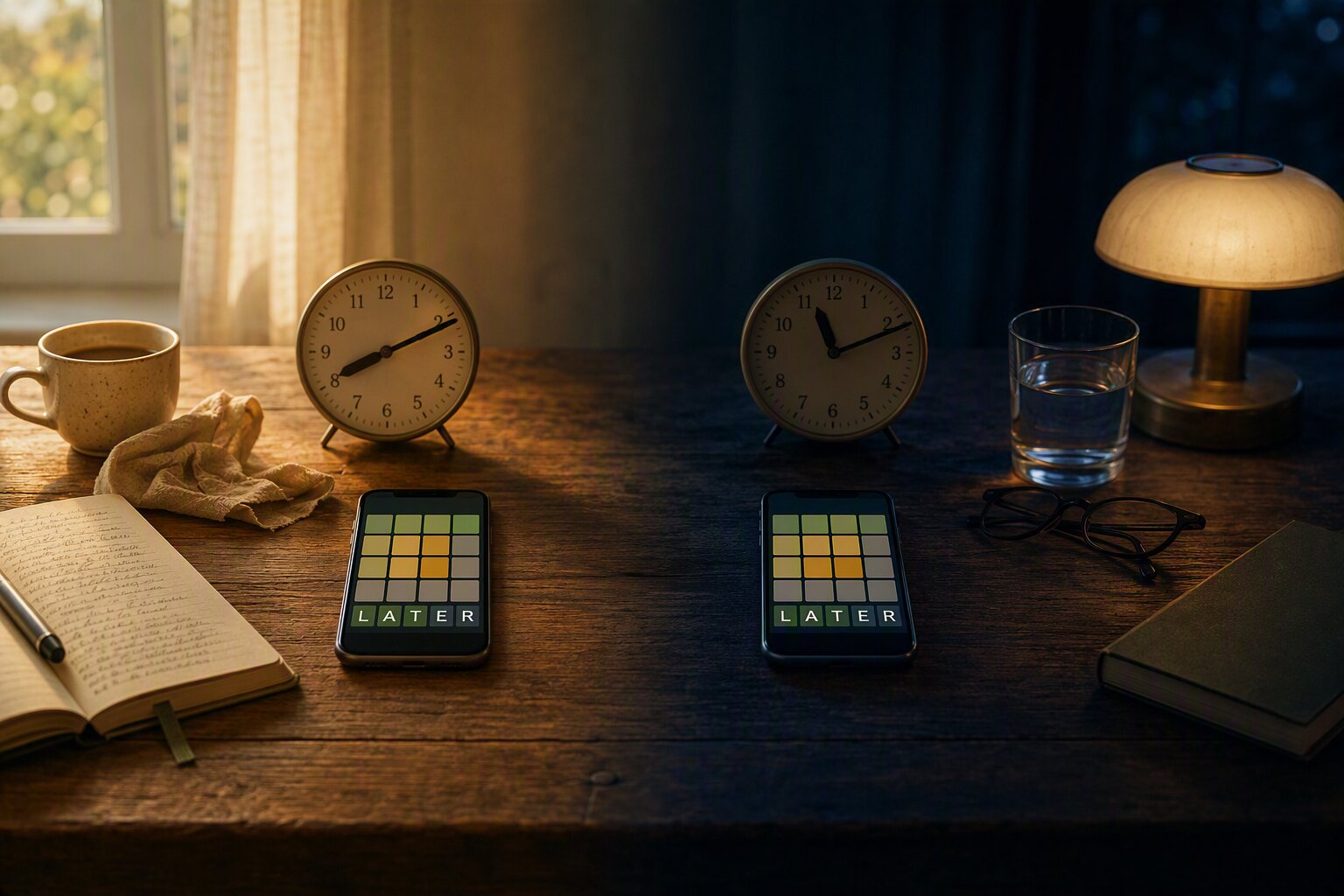
Someone suggests playing a word game together, one of you installs it, and a few days later you find out it only works when you're both at the screen. If there are six hours between you, that's usually the end of it.
So the question we cared about wasn't which game is best. It was narrower, and answerable from each publisher's own documentation: if I play my turn now and you open it at breakfast tomorrow, is the game still there?
For a fair number of the games people recommend for long distance, it isn't. Not because they're bad games, but because "multiplayer" covers two different arrangements and the lists tend to run them together.
The board either waits for you, or it doesn't.
Four things, one word
A game that waits. The board lives on a server. You move, it sits there, they move tomorrow morning.
A game you each play alone and compare afterwards. Two results and a screenshot, no shared board.
A live room. A link, both of you in it, usually with a call running alongside. Close the tab and it's gone.
Not shared at all. A solo game with a leaderboard or a share button, which sometimes gets listed as something to play together.
Games that wait
These keep the board on a server and give you a stated window to take your turn. The window is the useful number, and it varies more than you'd expect.
Words With Friends
The most forgiving of the lot. A game against a friend stays open for eleven days between moves, which covers a bad week rather than a busy evening; against a stranger it's five. Free with ads, on iOS and Android, still actively updated.
Zynga is retiring the browser and Facebook versions in September 2026, so if you've been playing on a laptop, that's ending.
Scrabble GO
Real Scrabble, seven days per move in the classic mode. Free, with ads and an optional subscription that removes them. Its Duels mode is fast and live, so "Scrabble GO is turn-based" is true of half the app. There's also a newer official Scrabble app in some regions, which publishes no inactivity limit at all.
NYT Crossplay
New in January 2026, so it hasn't reached most lists yet. Two players, competitive, seven days a turn, free with a Times account. The launch material calls it real-time competition, which sits oddly next to a seven-day window. Downloadable in France and Germany, but the game itself is in English.
Wordfeud
The first one we'd point at if English isn't the language you share. No time limit at all, up to thirty games running at once, and playable dictionaries in ten languages including French, German, Spanish, Dutch and the Nordic ones .
Codenames, but the app
Two products with the same name and opposite answers. The paid app has a two-player co-operative mode and gives you 24 hours a turn: $4.99 once, no ads, no in-app purchases, fully localised in seven languages including French and German.
The free website is a live room, built around both of you being on a video call. Same game, and lovely, but an evening thing rather than an anytime thing.
Letterpress and Word Chums
Both wait for you. Letterpress is a two-player territory game with a nice slow rhythm, but iPhone and iPad only, so it's out if one of you is on Android. Word Chums runs on both and is English only.
Games that need you both there
Nothing wrong with these. They're built for an evening you're both free, which is a different situation from being eight hours apart.
skribbl.io, Gartic Phone and Draw & Guess are timed rounds in a shared room. Gartic Phone has a second problem with exactly two people: the game is a chain of drawing and describing passed down a line, and a line of two barely gets going.
The multiplayer Wordle sites are simultaneous races, whatever a few of them say about taking turns.
Collaborative crosswords were the ones we most wanted to work, because a shared grid feels like something that should persist. Every platform we looked at documents real-time solving, and none of them promises the room survives you both closing it.
Games that only look shared
Wordle is a solo puzzle with a share button, and swapping results is a nice small ritual. It just isn't a shared board, and the puzzle appears at local midnight, so a big enough gap has you playing different words on what feels like the same evening.
SpellTower and Knotwords are single-player; Knotwords says as much on its Android listing. Both will share a result, neither shares a position.
The dividing line
Waits while you sleep
- Words With Friends, 11 days a turn
- Scrabble GO, 7 days
- NYT Crossplay, 7 days
- Codenames app, 24 hours
- Wordfeud, no limit
- Letterpress, Word Chums
The board lives on a server, so a time difference is only a delay.
Needs you both there
- Codenames website
- skribbl.io
- Gartic Phone
- Multiplayer Wordle sites
- Shared crossword rooms
- Draw & Guess
A live room, usually alongside a call. Close it and it's gone.
If English isn't the language you share
Store pages report the language of the menus rather than the language of the game, and a translated interface tells you nothing about the dictionary.
The two that state it plainly are Wordfeud, which publishes its playable dictionaries, and the Codenames app, whose word sets are fully localised. Words With Friends and Scrabble GO both offer French and German interfaces, but with those it's worth checking the dictionary inside the mode you actually play. Word Chums, SpellTower and Knotwords are English only; Letterpress adds Spanish and stops there.
One that got away
Draw Something had exactly the right shape for this. You draw, they guess whenever they next pick up their phone. It's effectively abandoned now, and the last Android build we could verify is from 2021, but it still turns up on lists as though it were maintained.
Does it matter whether you compete?
It would be tidy if co-operative games turned out to be better for couples than competitive ones. We went looking, and the evidence doesn't reach that far. The clearest experiment on the mechanic paired strangers online and found that co-operation raised enjoyment and closeness, with the effect running through how much the pair ended up talking. Suggestive, but strangers aren't a couple who've been together three years. The research that does involve couples is about gaming in general, it's correlational, and none of it compares co-operative play against competitive play directly.
Which leaves it down to the two of you. If one of you hates losing, that's more information than any of the studies offer.
The thing that sorted this list wasn't which game is best. It was what happens if one of us opens it at breakfast and the other at midnight. That turns out to be the difference between something you play twice and something you're still playing in March.
A note on sources: this comes from publishers' documentation, store listings and help pages, checked in August 2026. Where a limit isn't published we've said so rather than estimated one, and listings change without notice, so treat prices and availability as a snapshot.